Spider-view: "Deathweb"
This limited series utilizes shock and surprise instead of genuine connection to concoct emotional, personal stakes
—by Nathan on April 11, 2026—
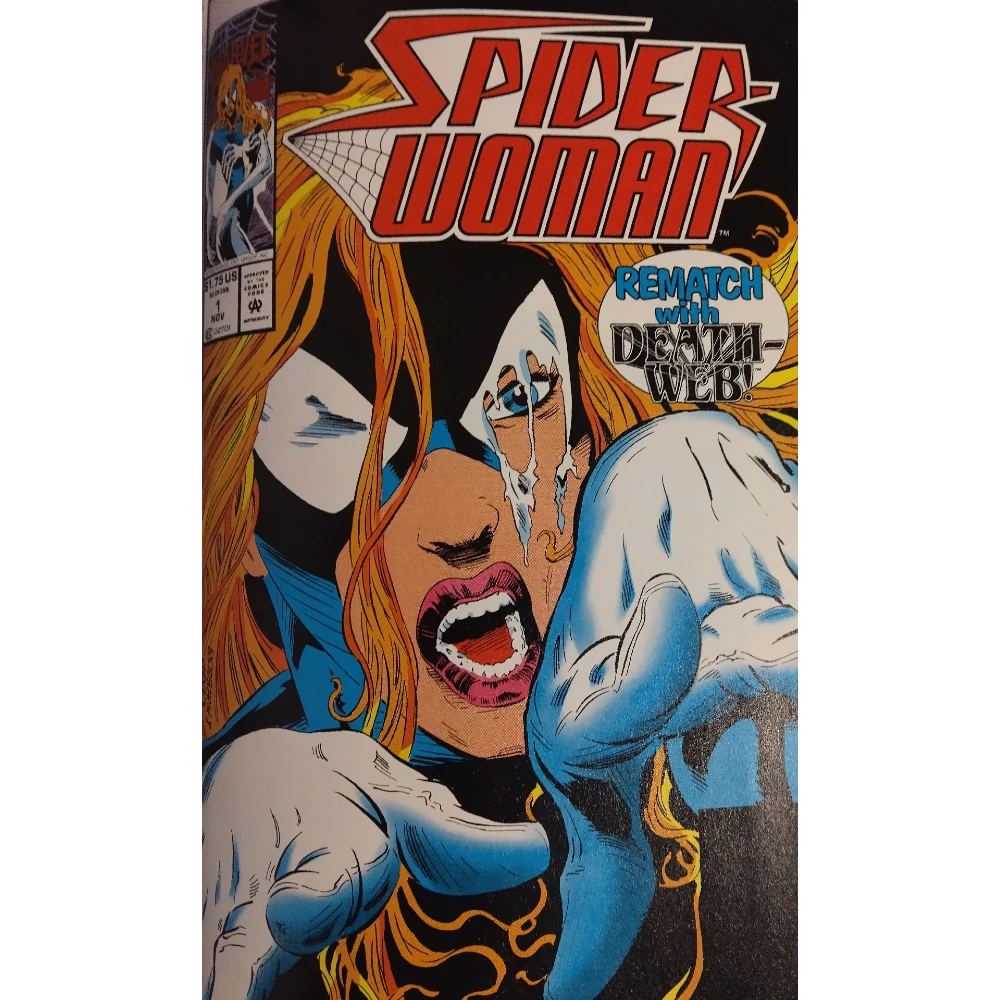
A few posts ago, I reviewed a West Coast Avengers volume containing what some folks consider to be one of the worst deaths in all of Marvel history: that of Barbara "Bobbie" Morse, aka Mrs. Clint Barton, aka Mockingbird. Two issues after her unfortunate murder at the hands of the demon Mephisto, the West Coast Avengers disbanded (though not specifically because Bobbie died), meaning that heroes such as War Machine, US Agent, and the focus of today's review, Spider-Woman, needed somewhere to crash. Don't worry, things worked out for them.
But that's a different review for a different day.
At the same time the West Coast team was crashing and burning, Julia Carpenter, the second Spider-Woman and widowed mother of one, was given her own four-issue limited series. I'm not quite sure what spurred on writers Roy and Dann Thomas and Marvel at large to gift Julia her own temporary title, other than she was a member of the amusingly nicknamed "Wackos" branch of the Avengers, despite their collective demise as an entity around those same months. Maybe it was to provide some more depth regarding her origin, revealed in a previous WCA arc, which this series certainly tries to do.
Even though Julia, at this time, doesn't have much connection with the regular star of this blog series, I just happened to spot this series in a 90s ad and decided to give it a shot. "Spider" is in the title, so this particular series of reviews feels like the best place to unpack whatever strangeness Roy Thomas decides to sic upon our web-spinning heroine in an arc I've elected to refer to as...
"Deathweb"
Writers: Roy Thomas and Dann Thomas
Penciler: John Czop
Inker: Fred Fredericks
Colorists: George Roussos and Steven Ellis
Letterer: Pat Brousseau
Issues: Spider-Woman (vol. 2) #1-4
Publication Dates: November 1993-December 1994
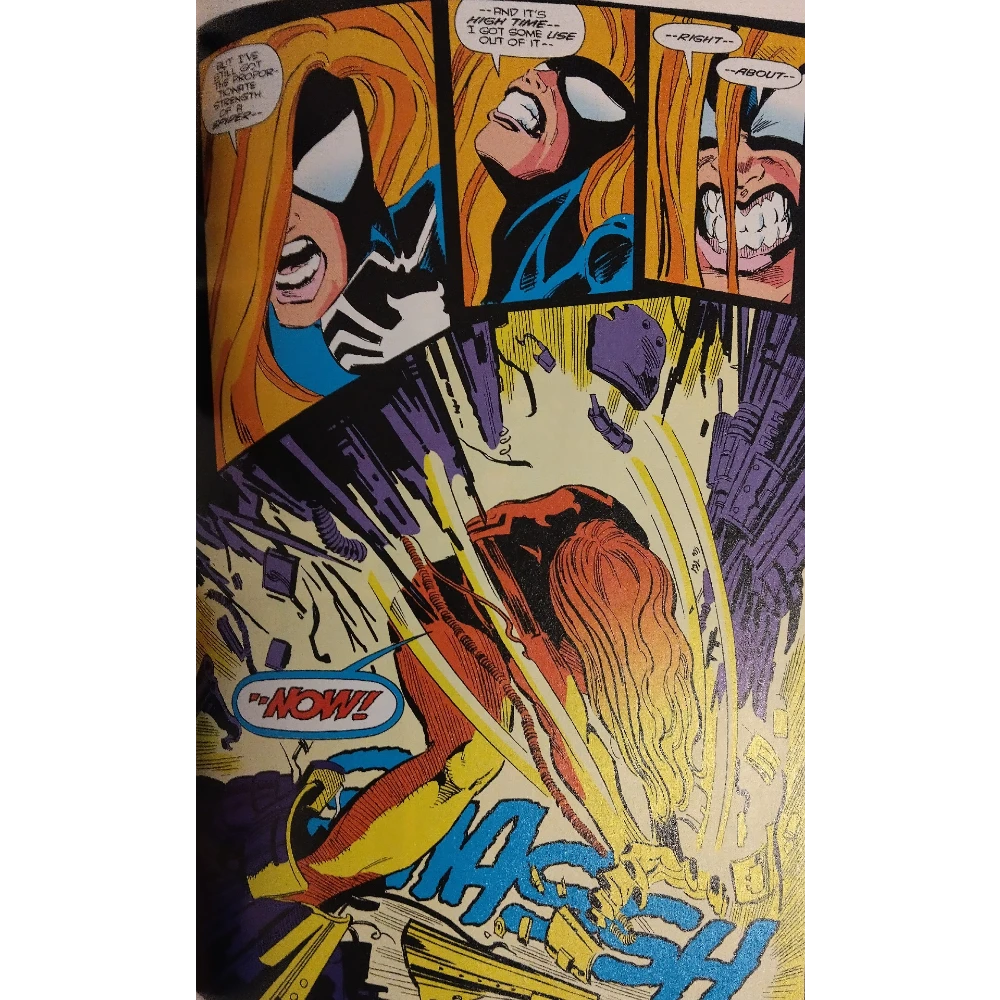
I've not read the West Coast Avengers arc which originally detailed how Julia received her powers, but as our husband-and-wife writing team shows in this series, whatever story readers (and Julia) thought they knew wasn't all there was to know. In typical comic book fashion, the Thomases dive a bit deeper into the past to tug some potential conflict out of previously unknown revelations.
There's nothing here which should surprise the reader in a "everything you know is a lie" kind of way, nor is there anything so ridiculously shocking as, for example, Roy Thomas having the US Agent nearly get murdered by a reincarnated Joseph Stalin (true story!). The crux of the twist circling Spider-Woman's past lies in Julia having been deceived as to the nature of some of her abilities and the exact process and reasons which went into giving her these powers, and if that's enough to generate motivation for Julia for taking down this series' villains, I guess that's enough.
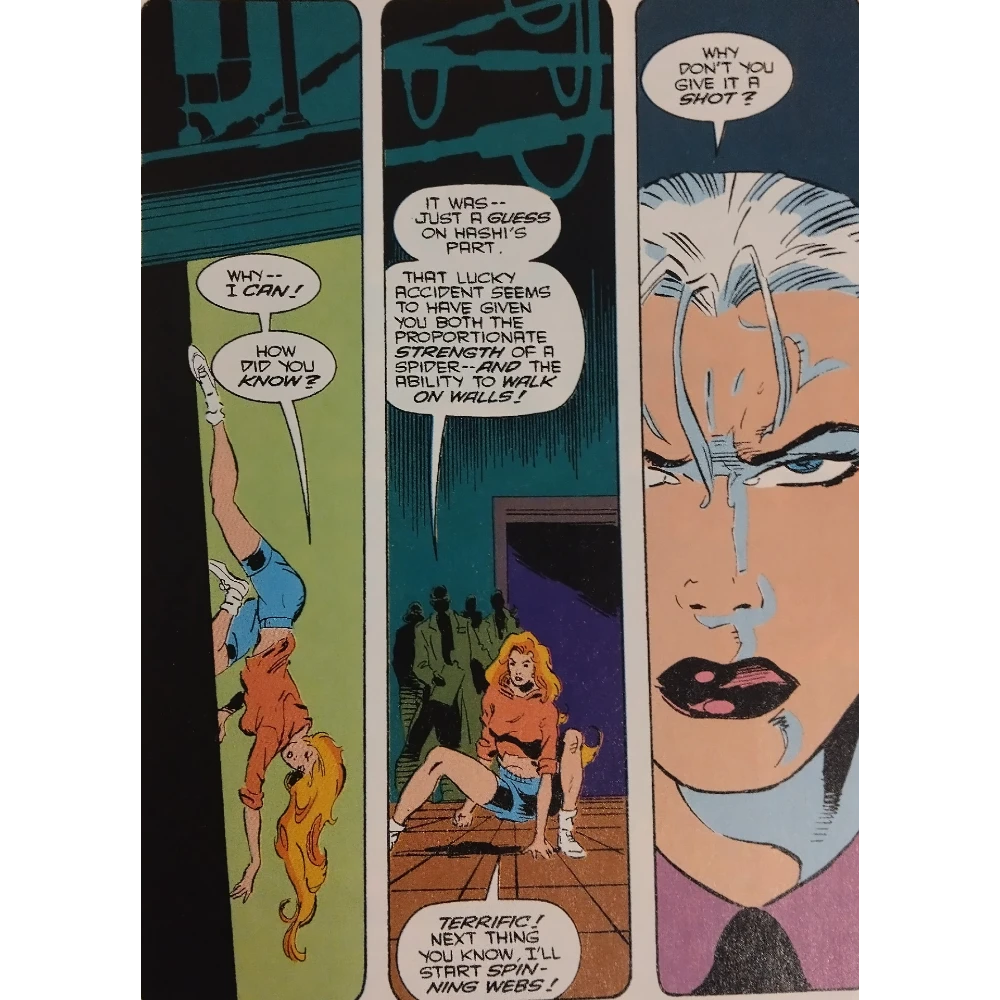
If I knew this version of Spider-Woman better, I may have felt a tad more interest in this retelling of her past. Julia is, appropriately enough, treated as somewhat of a victim of a government program. There's an interesting sinister-ness to the way her former friend and Commission on Superhuman Activities chairperson Valerie Cooper behaves, treated with much more competence than Peter David handled her on X-Force (though I'll note I don't mind his depiction of her character; it's just different than how she's portrayed here). Val feels more ruthless, not terribly apologetic in having manipulated the situation around Julia. It creates sympathy for our Spider-Woman, casting her as a lab rat in a vein similar to someone like Logan.
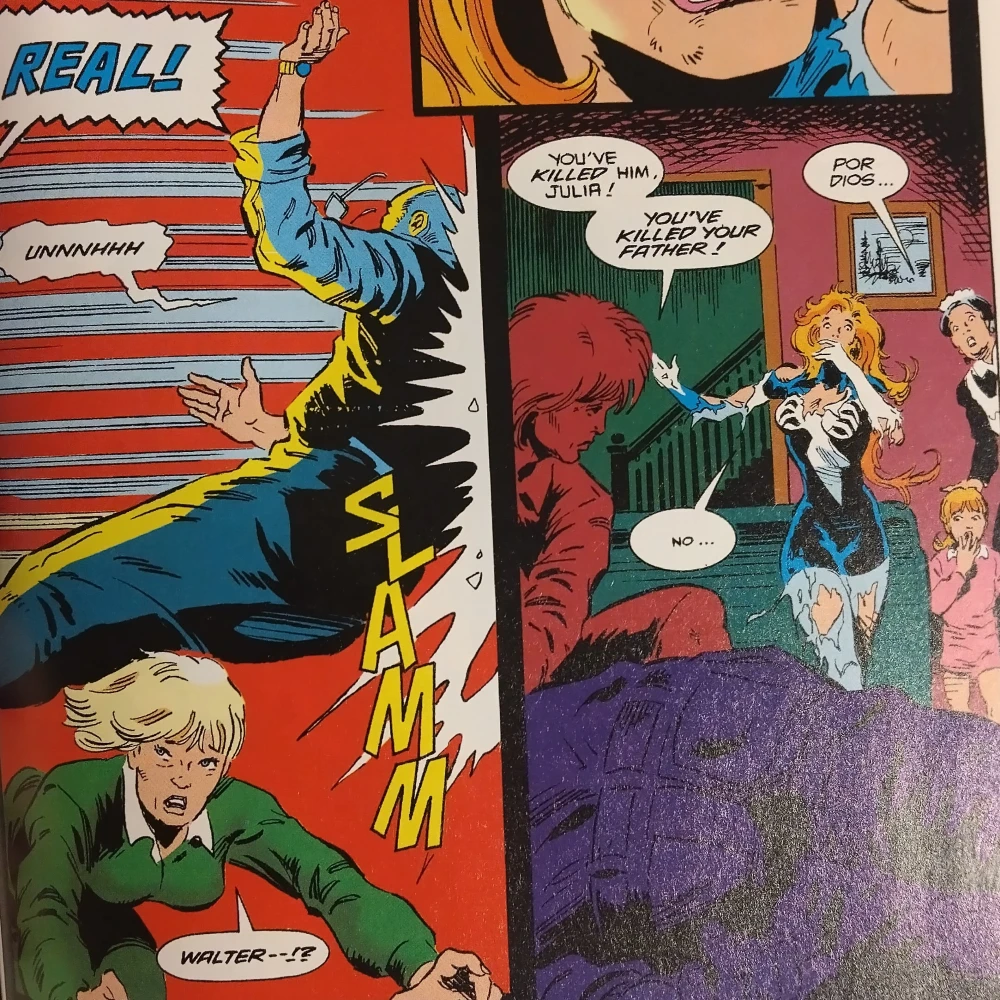
Though some of this sympathy is generated naturally, the Thomases turn to what I'll call "trickery" time and again to get a reaction from the reader, funneling in potentially surprising moments or oddly convenient plot points instead of laying out a better narrative. The plot sees Julia working to keep her family safe from a group of villains calling themselves Deathweb, whose origins are somewhat related to hers, as they work for a villain named the Manipulator, the man responsible for the death of Julia's ex-husband Larry. Enough tension arises from such a dangerous situation that the Thomases' efforts to supply additional moments of "Oh, no!" feel unwarranted. A bit where Julia accidentally hits her father, causing her mother to immediately proclaim his death, just seems over-the-top; similarly, a suddenly dropped bit of familial lore causes Julia some surprise, but it occurs so randomly and affects none of the plot afterwards that the impact is dulled. Nothing comes from these moments other than fleeting (if any) disquiet from the reader.
Which really feels unfounded. Imagine if Julia had accidentally killed her father. Whatever tension would come from that scenario certainly sounds more interesting that what we get here.
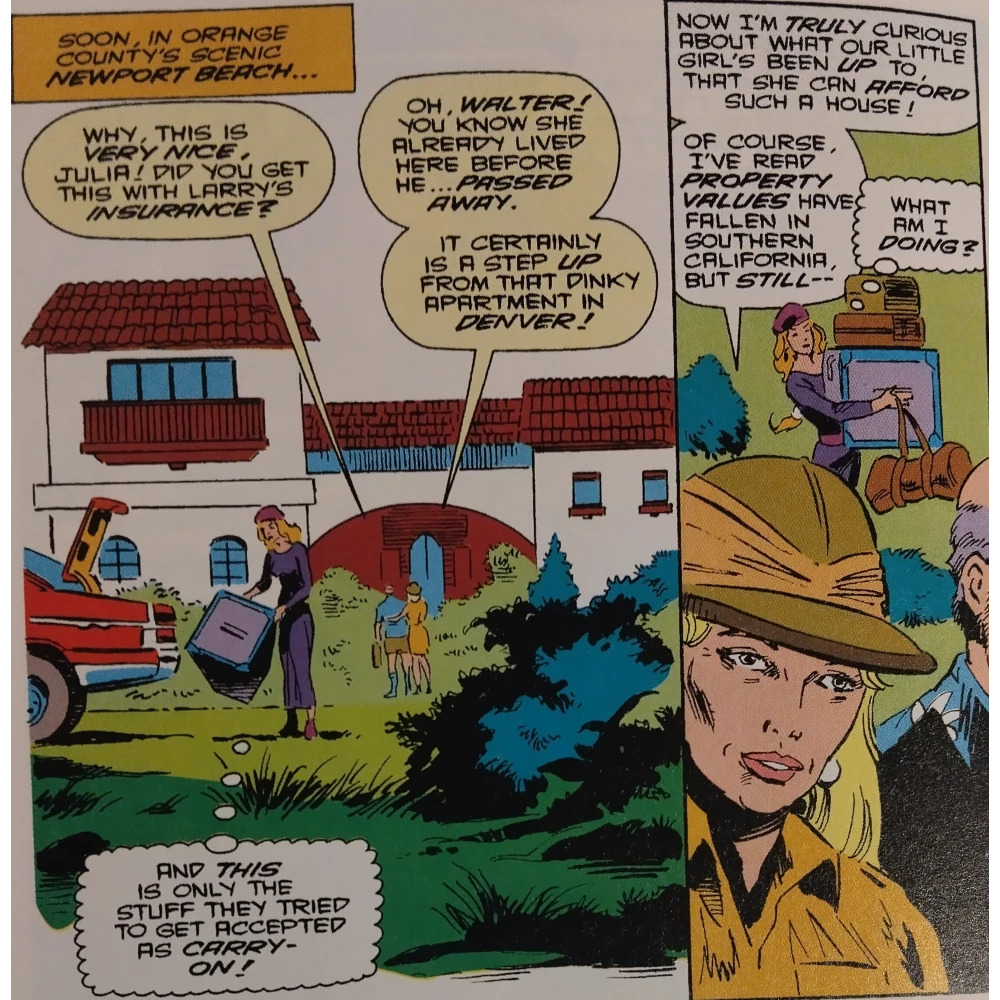
Better written are scenes between Julia, her parents (when she isn't brandishing a fist at her dad), and daughter Rachel, establishing a decent connection between them. You feel the care Julia posseses for her parents, plus the discomfort she feels by hiding her identity. Strands of tension regarding her ex-husband's death can be found here, too (though, I'll note, it never comes up in conflict with the Manipulator, who, if you remember, killed Larry), as her parents feel concern for her situation as a single mother (not initially knowing, of course, her mysterious "job" as Spider-Woman). When Julia seeks to save her parents and daughter from Deathweb, you understand and believe her motivations, though I'll be darned if I didn't wish the Thomases had capitalized on their relationship a bit more. A moment where Mr. and Mrs. Cornwall learn their daughter's masked identity could have led to some interesting dialogue, but it really goes nowhere.
That's probably the best way to describe the frustrating aspect of this series: "going nowhere." There are potential ideas to develop emotional connections between characters or give more weight to the conflict that the Thomases pass up. Julia wanting to save her family is a noble pursuit, and the bad guys using her family against her is a typically villainous ploy, but there are other notions which could have been explored that end up feeling limited or cut out completely in favor of shocking moments and plot twists.
As a villain, the Manipulator feels underused; having only appeared in a single West Coast Avengers issue prior to this, I guess I can't blame the Thomases for trying to build off thinly laid groundwork. He's a dude in a mask who coerces people into doing his bidding for him. That's his whole shtick, so the name fits him pretty decently. And, again, Julia never puts much stock into the whole "I want to (West Coast) avenge my ex-husband's death!" element, so whatever sense of justice you may feel once his scheme is ended evaporates.
Once again (and with all apologies to Roy "the Boy" Thomas) I find myself most sour on a story Thomas wrote. He's popped up several times in these reviews, fairly intentionally, but drenching his name in complaints was a fairly unintentional maneuver. It just so happens the narratives of his I've read recently, published during the late 80s and early 90s, haven't been all that entertaining. From penning detailed backstories, to devising crazy court cases, to revamping "modern" variations of earlier super teams, Thomas was doing what he could to maintain some standard of success during this era. I don't know how well this material was received at the time of publication, but thirty-plus years later, efforts such as this Spider-Woman series don't carry the emotional, developmental heft that I'm sure Thomas hoped they would.