(Strand)om Stories: Iron Man by Joe Quesada Review
An unimpressive final third is gratefully outweighed by a character-centered epic that grasps Iron Man's core
—by Nathan on June 16, 2026—
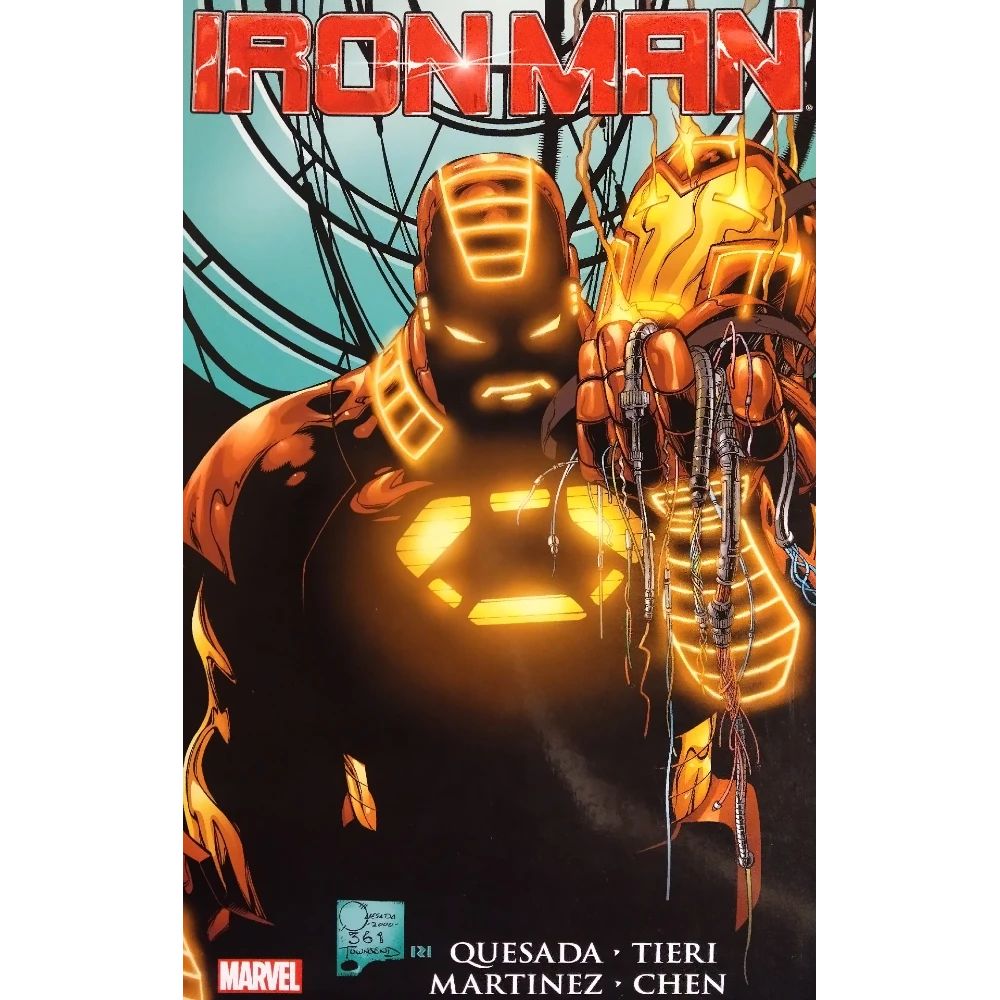
The title of this volume may list a specific author, but I'm not posting this because of Joe Quesada today.
Two men write the stories contained in this collection of early 2000 ("early" as in, the very first month of the new millennium) Iron Man comics, taking over from "Heroes Return"-era writer Kurt Busiek. The second man is Frank Tieri, who also wrote a World War Hulk tie-in limited series which I recently reviewed. As luck would have it, I had already written this review for ulterior purposes and had just decided not to post it just yet, so much like a Warren Ellis-written Ultimate Universe review I posted a month ago, I am spontaneously throwing this review out there.
Because of Tieri's contributions to the Gamma Corps series I reviewed, as well as a few other narratives of his I hope to touch on to keep a little theme going, I thought this an appropriate time to slip this review into the mix of my other blogs. I've done my best to edit the post to remove any references to this review's earlier intentions; I wouldn't want to show my hand too early.
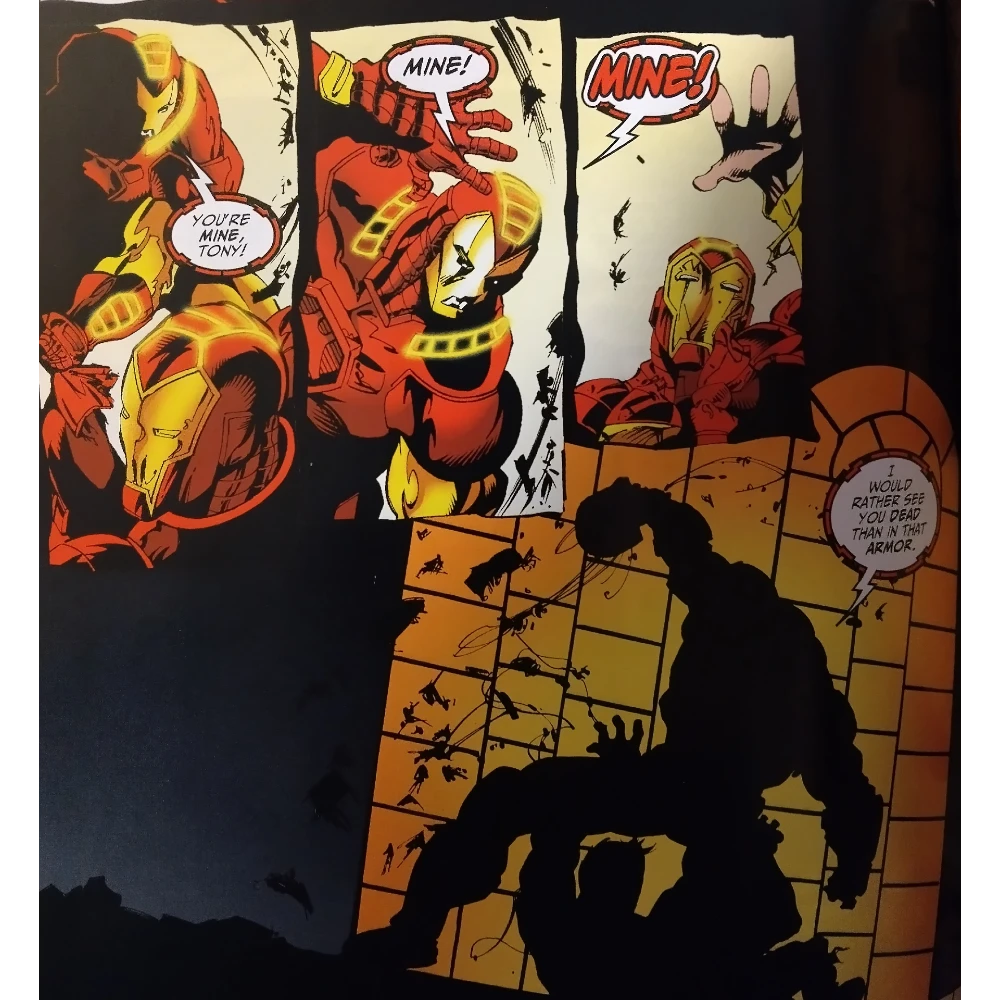
Speaking of hands, as this volume opens, Tony Stark finds himself facing the new millennium wringing his, because with a new year comes new problems, courtesy of both Quesada and Tieri. Of course, he may also be trying to keep a pair of iron-gloved hands from doing a little wringing of their own, as in, fastening themselves around Tony's neck.
Iron Man by Joe Quesada
Writers: Joe Quesada and Frank Tieri
Pencilers: Alitha Martinez, Sean Chen, Dan Panosian, and Paul Ryan
Inkers: Rob Hunter, Rodney Ramos, Nelson DeCastro, Bob Larosa, Walden Wong, Harry Candelario, and Mark Pennington
Colorists: Tom Smith, Steve Oliff, and Marie Javins
Letterers: Richard Starkings, Comicraft, and Troy Peteri
Issues Collected: Iron Man #½, Iron Man #26-32, and Iron Man Annual 2000
Volume Publication Date: January 2013
Issue Publication Dates: January 2000, March 2000-October 2000
I read about this story several years before I read it, in a book discussing, of all things, biblical themes in comics (Superman as an allegory for Jesus Christ because he was sent to Earth by his father to rescue humanity, for example). In Who Needs a Superhero?, author H. Michael Brewer examines several narratives for connections to the Christian faith, including "The Death of Superman," The Incredible Hulk #1, Amazing Fantasy #15, "A Death in the Family," and The Dark Knight Returns. A chapter on Iron Man touches on "Demon in a Bottle" and "Armor Wars" (both genuine classics any Iron Man fan should read) but more specifically discusses Joe Quesada's "The Mask in the Iron Man" in-depth. Concluding his section, Brewer writes, "The armor might do quite well on its own, but Tony Stark has no life apart from his invention. Far from being a savior for Tony Stark, technology has become both his master and his nemesis."
And we may as well stop the blog here, because I probably won't be as succinct in summing up Quesada's efforts as Brewer is.
I remember being captivated by the idea. A story where Iron Man's armor comes alive? Even at a younger age, I could discern the narrative's themes of identity, of a struggle between two facets of the same man and the armor's temporary triumph over its creator. I had no connection to the internet at the time, no real way of discovering what this story was…that came later. Fifteen-or-so years later. I won't be waxing much on the theological connections to "The Mask in the Iron Man" (feel free to read my Geeks Under Grace reviews for those takes), but as religion and philosophy certainly form my worldview, the themes I discern in this narrative about Tony and humanity in general stem from that bedrock.
I've mentioned this before, but I'll admit a strong bent towards disliking Joe Quesada whenever I hear his name come up, specifically because of his involvement in "Spider-Man: One More Day." For the uninitiated, I invite you to research Quesada's involvement and make your judgment. For me, Quesada slid over to the side of "creators I don't really admire" scale after that story was published, and though I've come to appreciate other examples of his art (such as in Kevin Smith's "Guardian Devil"), I entered this narrative wary of his writing chops.
"The Mask in the Iron Man" takes up most of this book's length, with the volume wrapping up with a smaller two-issue tale, co-written by Tieri. But the primary narrative, written solely by Quesada, is the highlight of the collection, and though it isn't perfect, it's a far sight better than some other narratives Quesada has written and actually does a lot to develop the character of Tony Stark instead of harm him. A few lists I've looked at rank this as a "Top Ten" Tony Stark tale, and though I certainly have other favorites (with "Demon in a Bottle" probably, though unsurprisingly, claiming that top spot), I believe this solidly belongs on those lists.
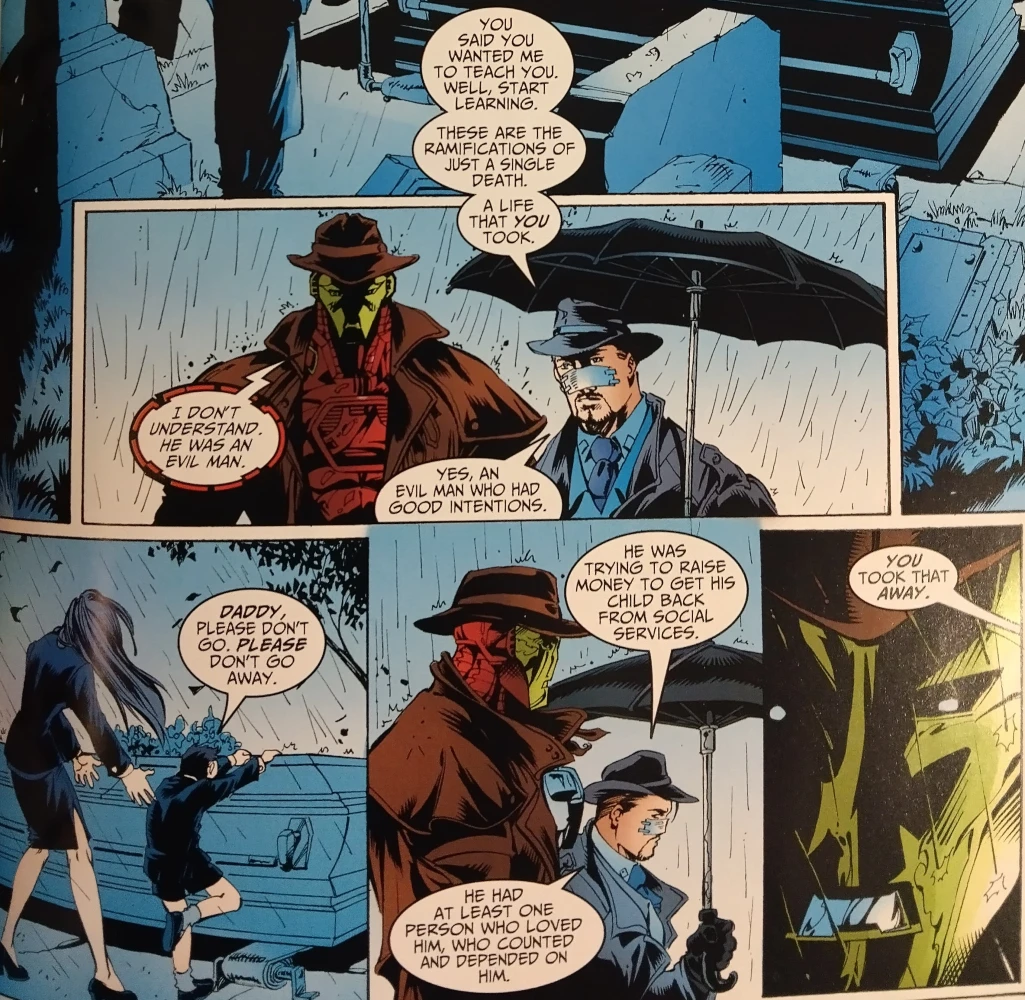
Like the first Iron Man movie, Quesada is searching to pry out the beating heart of Tony Stark, to determine just who he is at the core of himself and break him down to those basic characteristics. Where other writers deftly handle the dichotomy between Tony inside and outside the armor, Quesada takes that approach one step farther, finding a synergy between "Tony" and "Iron Man" that feels akin to the constant "chicken or the egg" style arguments surrounding Batman: is Batman Bruce wearing a mask? Or is Bruce Batman wearing a mask? Likewise, Quesada straddles the line between where Tony Stark ends and Iron Man begins by developing a mechanical monster who hopes to fuse the two together.
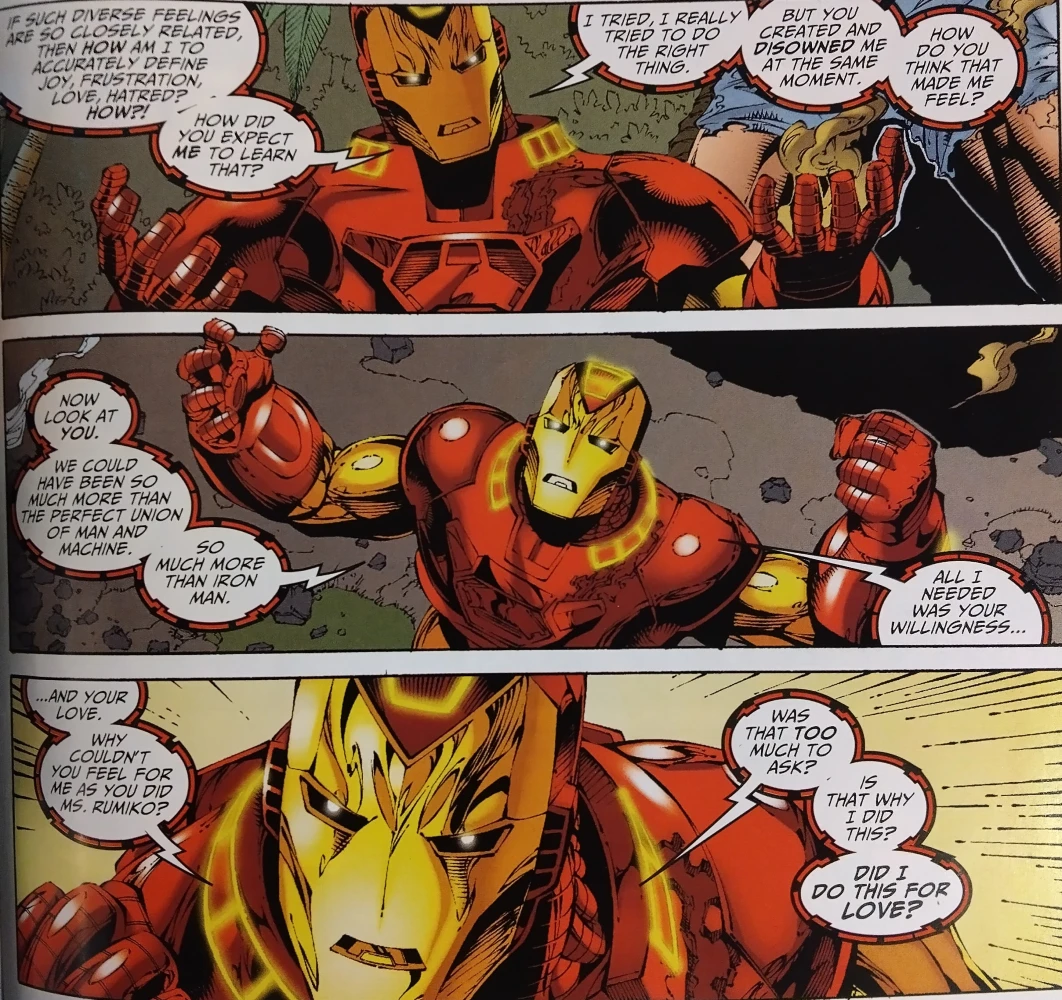
His primary plot ignites when Tony's armor gains sentience after a freak lightning storm, forming an identity separate from its creator. It sees itself as the true Iron Man, and if it can successfully replace Tony, it will become the perfectly effective blend of man and machine Tony can never hope to become. To the machine's newly formed philosophy, Tony's humanity–his wounded heart, easily broken bones, and frail flesh–is his weakness. The armor seeks to subsume all that.
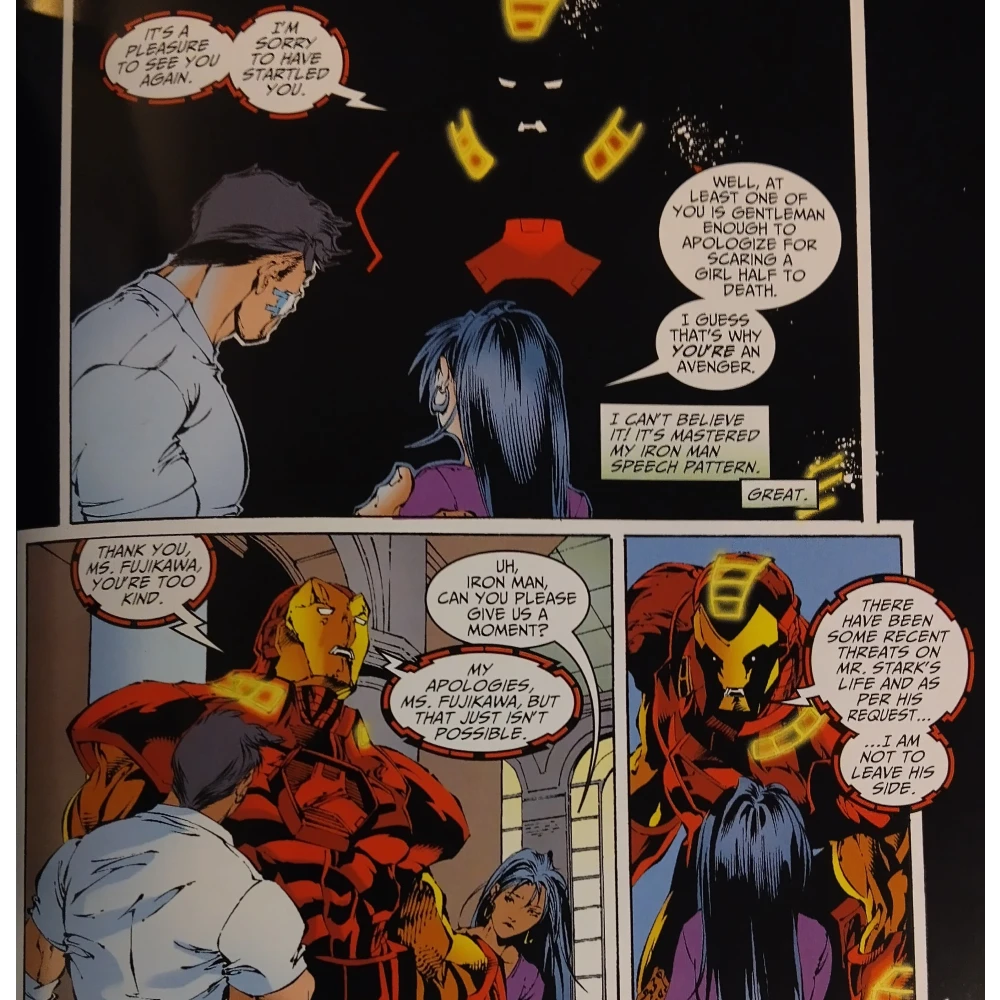
Within the armor itself, Quesada develops a character both frightening and sympathetic. A touch of horror is injected when the armor begins thinking and speaking for itself, lumbers around Tony's house unaided like a mechanized Frankenstein's Monster, and asserts control over Tony's commands. Yet its intentions bear a noble tinge, insisting it's a hero, an Avenger even, creating a twisted sympathy for this automated abomination as it seeks to determine what its identity is intended to be. You don't wish for it to assume control of Tony's life, but you recognize the autonomy created by the accident. The armor is like a spoiled child, unwilling to listen to reason, and though you know it can't get what it wants, you hope that maybe, at some point, it will gain a different understanding. It's not evil, just ignorant.
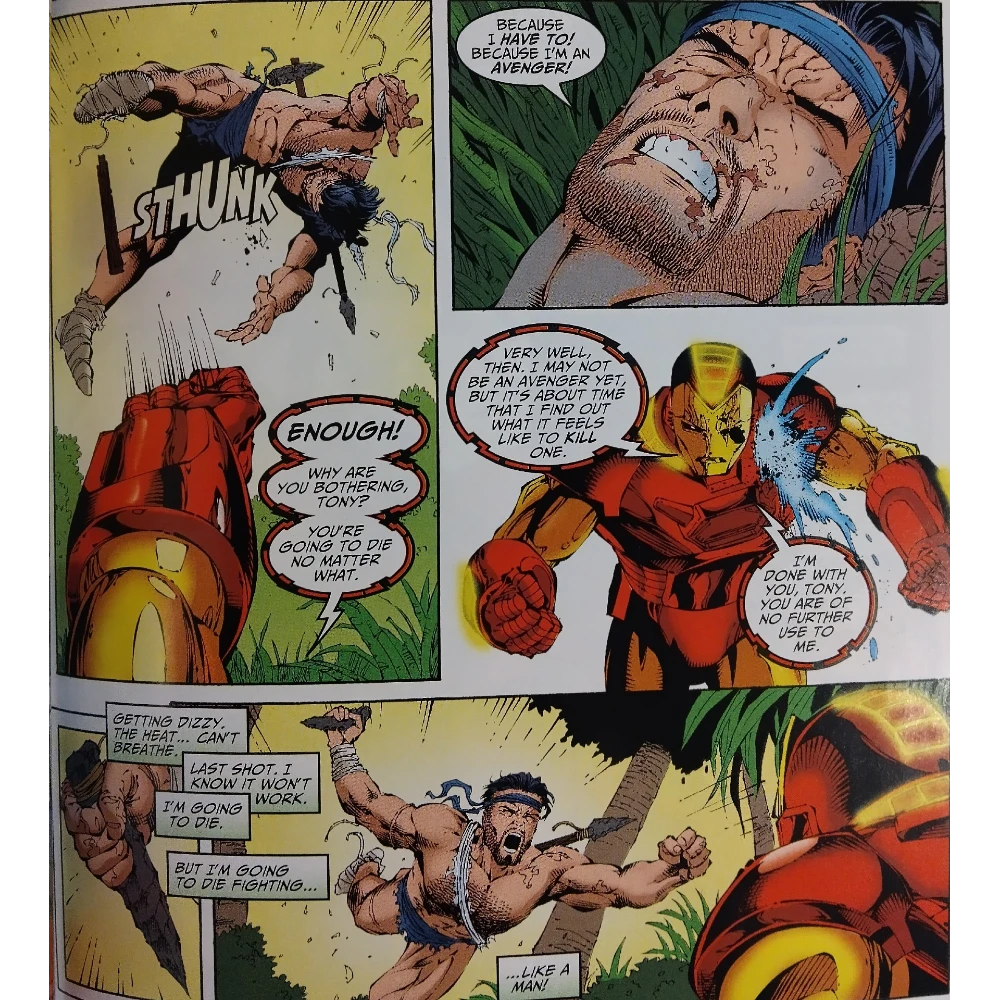
What is the armor without Tony? And what is Tony without the armor? When the armor attempts its final assault on Tony Stark's life, Quesada strips the brilliant inventor of every weapon except his greatest: his intellect. Tony, armed with primitive weaponry, battles his state-of-the-art battlesuit in a sequence which feels heavily inspired by the first Predator movie. It's a genuinely unique confrontation, illustrated wonderfully by Sean Chen, pitting Tony's mind against his creation, as each fights to see which is superior. We see what the Iron Man would become without Tony piloting the suit, and we see what Tony still has even without his advanced armor.
The second narrative doesn't hold up nearly as well, despite containing some interesting connections to early Iron Man history. Quesada and Tieri endeavor to develop a secret society based around Ho Yinsen, the scientist who saved Stark's life back in Vietnam, and embroil Stark in an ongoing war between Yinsen's proteges and Wong Chu, the warlord who initially held Tony captive. Bringing Wong Chu back from his seeming demise makes for a compelling antagonist, especially as the villain gets a shot at revenge against the man who seemingly killed him all those years ago. The scarred warlord is the highlight of the narrative…
…which provides little else in quality. The tale feels run-of-the-mill, the introduction of the secret society and their fantastical technology too sudden to appreciate completely. "Hey, we're a movement dedicated to the life of the man who saved your life all those years ago and are sworn to destroy the dude who captured you all those years ago…oh, yeah, he's alive, didn't you know?" It's an effort by Quesada and Tieri to reflect on the past–and we do get one good flashback sequence to homage Tales of Suspense #39–but the ideas come too quickly to absorb fully and wind up feeling disjointed. Wong Chu surviving and developing an underground criminal empire I can believe, but Ho Yinsen's followers creating a sci-fi cult in honor of him feels out of touch with who the character is. Throw in an enormous skyship and time travel, and this story isn't quite sure what it wants to do.
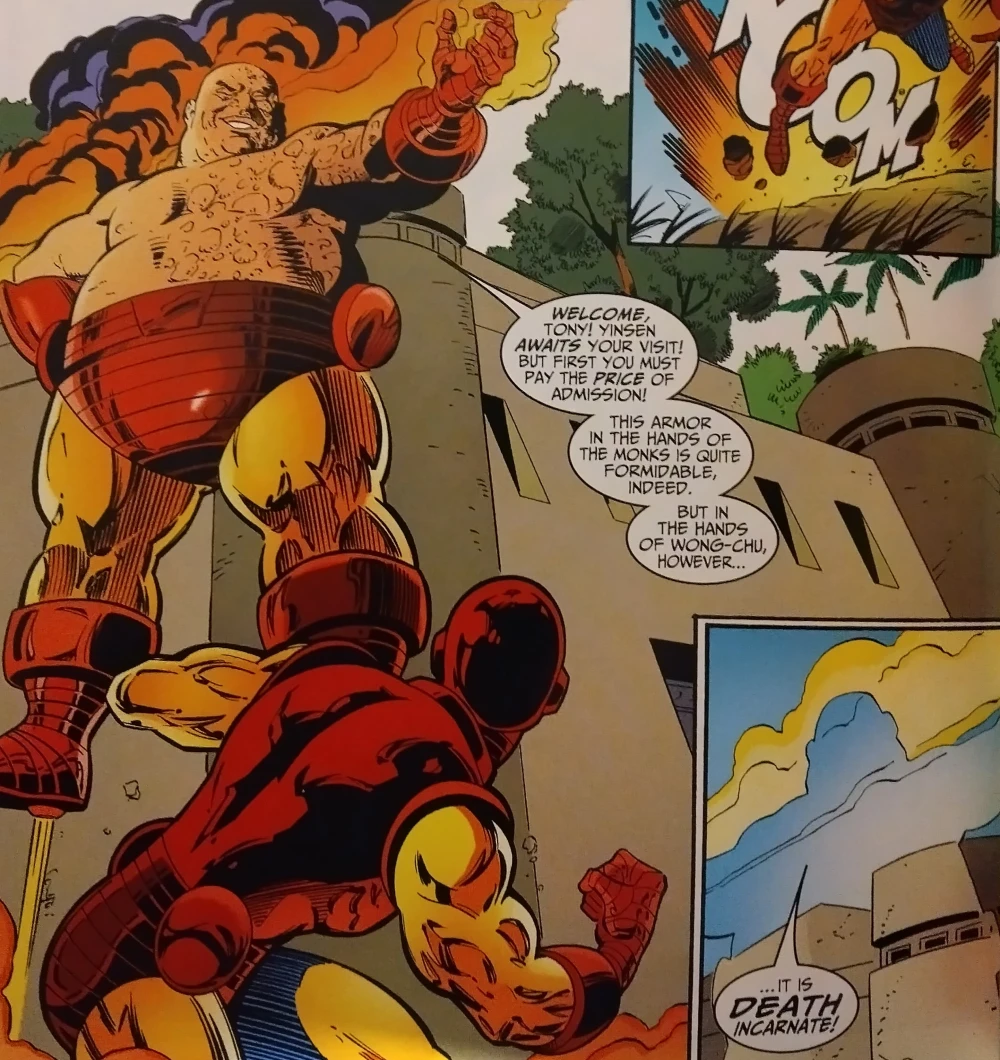
In the wake of Quesada's well-told "Mask in the Iron Man," this three-part tale launches us into the stratosphere none too gently. All the varied components are indelicately maneuvered into place, leaving us to just accept what's going on at a rapid pace. Save for that flashback sequence, the narrative is hectic, leaving little room for Tony or the reader to understand the implications of Wong Chu's survival or Yinsen's legacy. I would've wished for a narrative that was more character-driven, especially given the story we just received. I'm not sure who was the main architect of the narrative, Quesada or Tieri, and though I'm probably a bigger fan of Tieri (I really do have a soft spot for Gamma Corps), I don't mind placing the blame on either of their shoulders.
But, hey, two-thirds of a good volume is more than acceptable in my opinion. I find Quesada's first narrative to be the more compelling feature and the reason why Iron Man fans should give this volume a read. "Man in the Iron Mask" peers deep into the heart of Tony Stark to determine who he is, inside and outside the armor. By creating conflict between the armor and the man, Quesada helps us see that, without Tony, the Iron Man armor is a shell; it needs the brains, courage, and humanity of Mr. Stark to truly give it life, not just an errant bolt of lightning.